Trump Announces Full Naval Blockade of Venezuela's "Sanctioned" Oil Exports
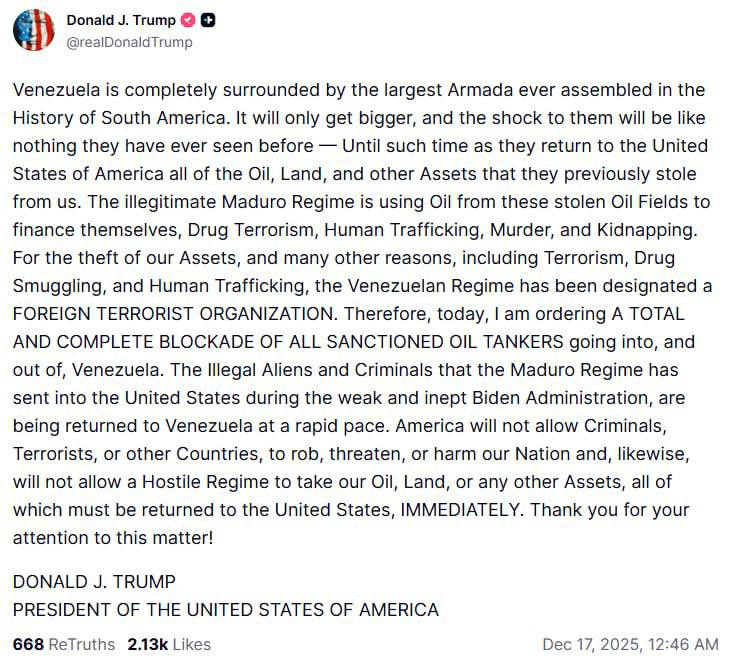
It appears the Trump administration is finally preparing to escalate the Venezuelan conflict once and for all, after Trump himself had told reporters that ‘ground strikes’ would begin ‘soon’ on Venezuelan soil. Trump then jumped the shark with his announcement of a full-scale naval blockade of Venezuela’s oil tankers in the most pompous way befitting his usual deportment:
This was after US Special Forces had already seized an oil tanker off the coast of Venezuela just last week, allegedly for carrying “sanctioned” Venezuelan oil for export. A convoluted backstory was concocted about how the tanker was tied to Venezuela’s “shadow fleet” with links to Hezbollah and Iran—if you can believe the absurdity:
On 10 December 2025, the United States seized the oil tanker Skipper in the Caribbean Sea off the coast of Venezuela. Skipper had been sanctioned by the United States Department of the Treasury in 2022 for alleged involvement in an oil trafficking shadow fleet of vessels involving the Islamic Revolutionary Guard Corps and Hezbollah.
Recently, reporters even asked Trump whether the blockade was more about “drug trafficking” or actually “oil”, with Trump implying that it’s about all of those things combined and more, essentially giving up the imperialist plot in one fell swoop.
Now, as seen in the earlier written screed, Trump has doubled down on his latest narrative motif, accusing Venezuela of “stealing” US’s oil:
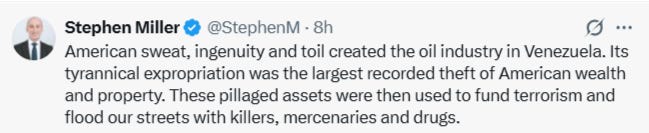
Top Trump advisor and WH Deputy Chief of Staff for Policy Stephen Miller piggybacked the escalatory rhetoric:
Here a Russian analytical channel provided the real scoop on this so-called stolen oil:
What “stolen” oil is Trump talking about?
On February 28, 2007, Hugo Chavez, the then-president of Venezuela, signed a law on the nationalization of oil fields.
All foreign companies operating in the country were offered to join joint ventures, in which at least 60% of the shares would belong to the state-owned company PDVSA.
The presidential decree affected American companies Chevron Corp., ConocoPhillips, Exxon Mobil Corp., British BP, French Total SA, and Norwegian Statoil ASA, which lost control over oil fields being developed in the Orinoco River basin.
At that time, foreign investors retained some autonomy only in the oil fields of the Orinoco oil belt, where they had played a leading role before the law was signed. In the 1990s, the Venezuelan government allowed foreign players into Orinoco because the fields there were considered unpromising and required large capital investments.
However, gradually, leading foreign companies increased oil production in Orinoco to 600 thousand barrels per day. From the very beginning, foreign players carried out exploration, production, and costly primary processing of crude oil in the Orinoco fields jointly with PDVSA.
According to some data, the amount of investments of the aforementioned companies in the subsequently nationalized assets amounted to at least 17 billion dollars.
Some of the claims of foreign oil companies were later satisfied by the Venezuelan authorities through direct monetary compensation.
But not all of them, and the issue is still not fully resolved: some firms are still demanding compensation and have cases in foreign arbitration bodies.
#Венесуэла
Military Informant
As an aside, an oil tanker named Hyperion reportedly belonging to Russia’s own so-called “shadow fleet” has been approaching Venezuela, with many tensely awaiting US’s actions as a litmus test of how much of a ballsy ‘hardball’ style of confrontation US will dare against Russia directly:
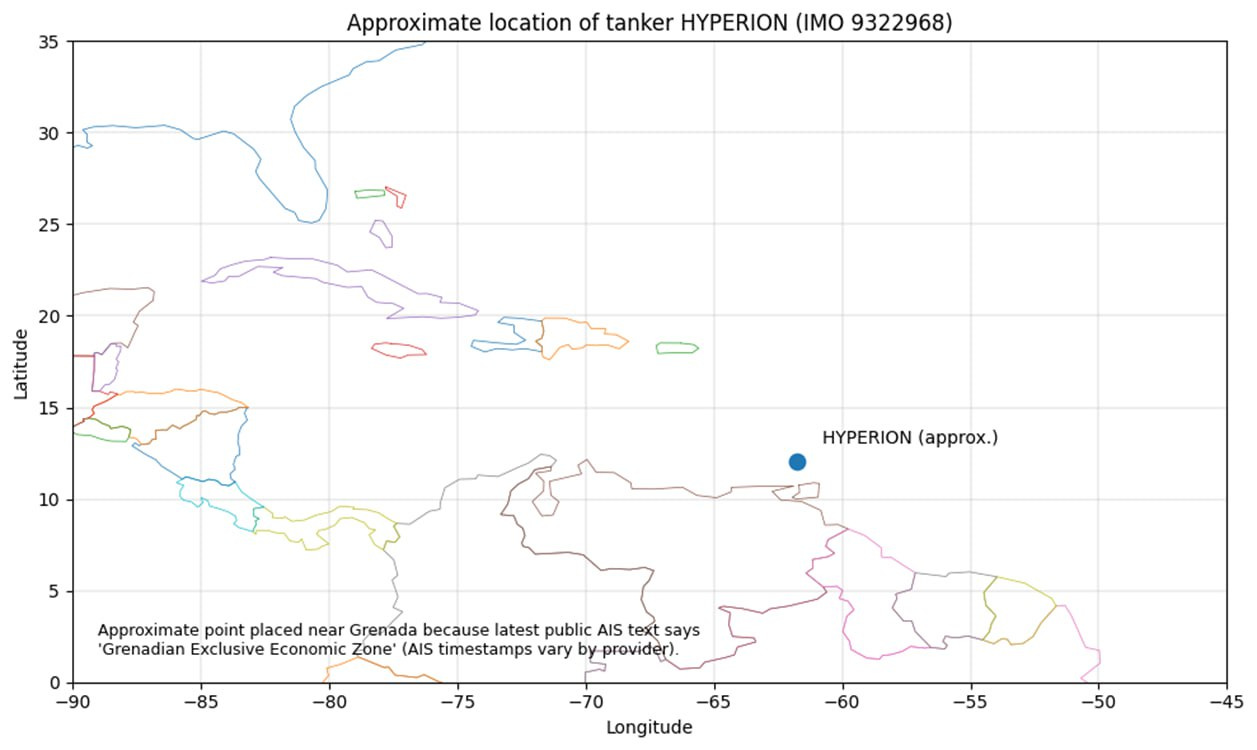
It’s interesting that the Russian tanker “Hyperion” has entered the Carribbean waters heading towards Jose Terminal, Venezuela.
The ship is under US ‘OFAC’ sanctions....meaning it’s part of the so called “Shadow Fleet”
Independent maritime tracking sources have reported that sanctioned Russian tankers are continuing to operate to Venezuelan terminals such as Jose Terminal, even while Washington tries to interdict them. -
It has also been reported that Russian tankers transiting the Baltic Sea have now begun sprouting armed sentries, which have spurred ‘whispers’ about the precise ‘nature’ of these security details:
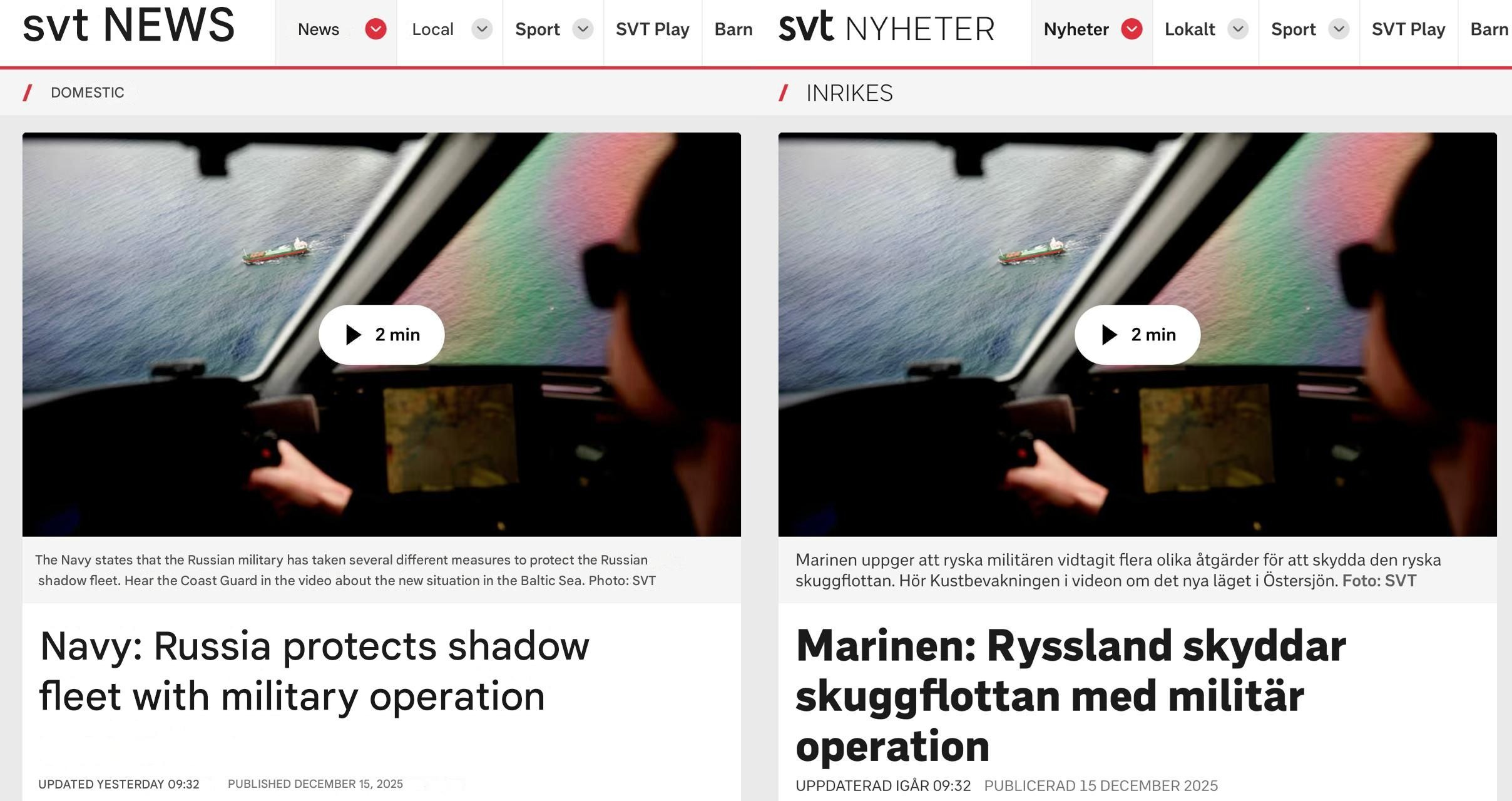
A strange situation is being reported in the Baltic Sea. The Swedish Navy reports that armed men in military uniforms were spotted on board Russian oil tankers of the “shadow fleet” in the Baltic Sea.
The shadow fleet of the Russian Federation is being protected by military personnel, stated the head of the operational command of the Swedish Navy, Marco Petkovic, on air of the Swedish TV channel SVT Nyheter.
According to him, military personnel in uniform and armed men - presumably employees of private security companies - were spotted on Russian oil tankers operating in circumvention of Western sanctions.
One of the winking whispers, thematically, from a top Wagner-affiliated channel:
The private security guards protecting tankers from pirates are suspiciously young, slim, and adept at handling weapons.
Now, there are new rules for the quest involving the “shadow fleet”, including the use of anti-tank guided missiles and Strela missile systems.
Well, that’ll give the peg-legged Baltic buccaneers something to chew on and shiver their timbers over.
Russia’s Lavrov rightly highlighted the Europeans turning a willfully blind eye to the US’s illegal Caribbean piracy in order to appease Trump—maybe a kind of one-eyed pirate’s code. From RT:
Europe is silent on US attacks in the Caribbean to gain Trump’s favor over their Ukraine peace plan proposals — Lavrov
Russia is ‘concerned’ with US Navy striking civilian boats and a probable land op
‘Almost all of the countries find it unacceptable apart from the Europeans’
It’s just more of that famous Ruse Based Ordure’s doppelmoral.
And speaking of the West’s moral and ethical standards:
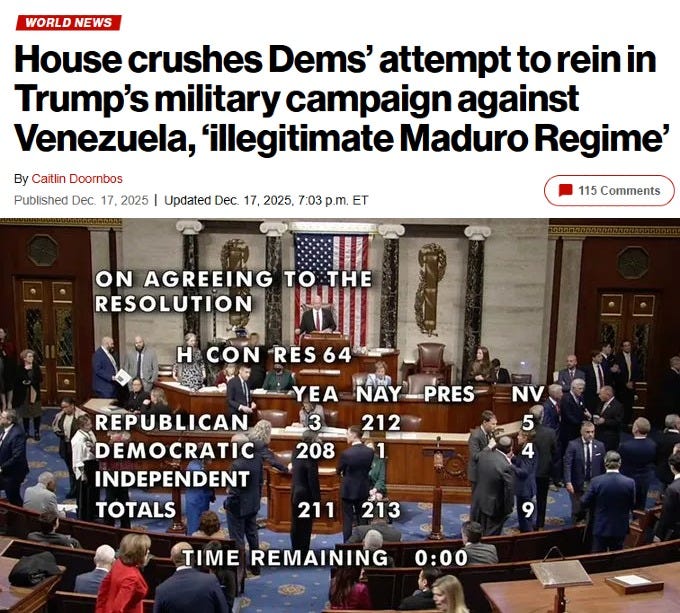
House REJECTS Venezuela war powers resolution by two votes
Democrat-pushed bill would have blocked Trump from taking military action against Maduro
One less obstacle for Trump
Switching over to Russia, Putin gave his own end of year military update, where several interesting statements were made.
Here he reiterates that Russia would ‘prefer’ to solve the military conflict via diplomatic means, but if impossible to do so, will certainly solve it militarily:
Here Putin makes a classic statement—that Russia once aspired to join the ‘civilized’ world of the West, but now realizes there is infact nothing there but degradation:
Putin even caused a huge fuss by calling European leaders “piglets”:
Though Dugin dished on the nuance:

Belousov likewise announced that, according to the Russian MOD, Ukraine has lost 500,000 KIA, with 1.5 million total casualties:
This graphic was presented, showing 1,496,700 casualties, 213,000 pieces of military equipment destroyed, as well as 70% of Ukraine’s energy capacity in thermal power plants knocked out along with 37% of hydroelectric assets:
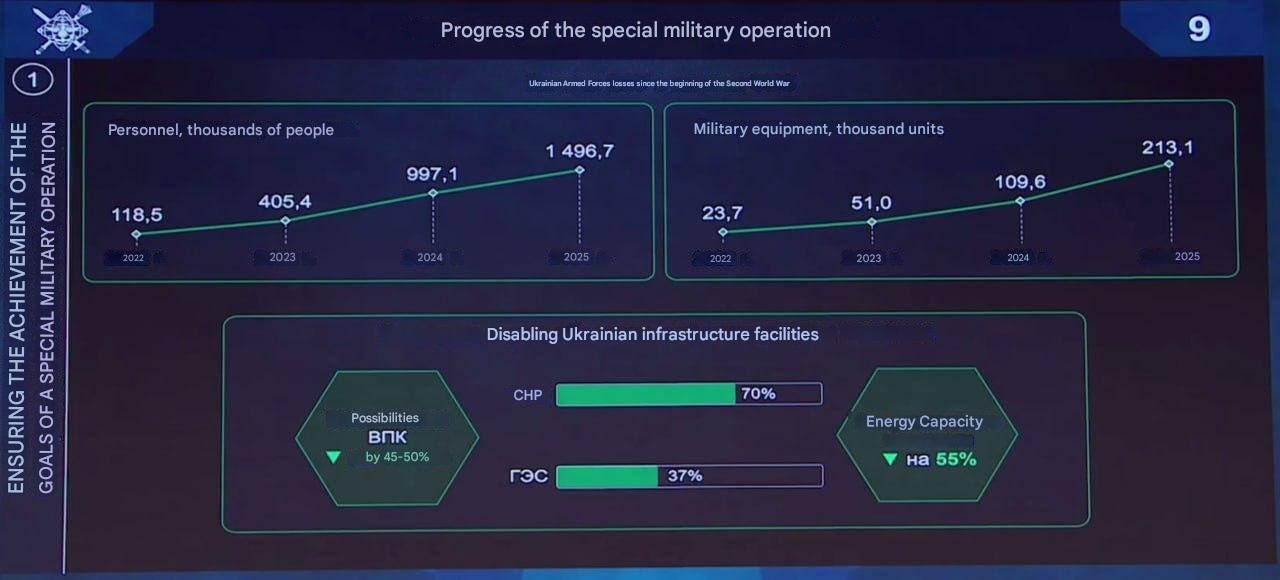
In Ukraine, more than 70% of thermal power stations and more than 37% of hydroelectric power stations have been put out of action, Belousov reported. Kiev’s energy capabilities have decreased by more than half.
The effectiveness of targeted strikes by Russian troops is an order of magnitude higher than that of the Armed Forces of Ukraine.
Another revealing statement from Belousov concerned Russia’s drone usage. For a long time we were given Ukraine’s own official figures for how much of Russian losses are caused by drones versus artillery, etc., but until now we didn’t have Russia’s version of those figures.
Here it is revealed that Russia apparently inflicts 50% of its losses on the enemy via FPV drones:
The formation of the Unmanned Systems Troops will be completed in 2026, said Belousov. He pointed out that the nature of the Russian army’s actions has changed.
Now, up to half of the enemy’s losses are due to FPV drones. The Russian Armed Forces have achieved a twofold superiority in the use of UAVs over the enemy.
“At the forefront of the troops are the ‘Rubicon’ units. They have destroyed more than 13,000 units of weapons and equipment, which is more than a quarter of the results of fire damage by unmanned aircraft. The ‘Rubicon’ center has received international recognition. Its combat experience is reflected in publications of major international publications, including American and British ones. And the Kiev regime has declared ‘Rubicon’ a threat to national security,” said Belousov.
▪️The Russian army in 2025 received ten times more motorcycles and buggies than in 2024.
▪️The increased mobility of units allows them to break through the ‘drone wall’ that Kiev is trying to build.
▪️This year’s recruitment plan for the Russian Armed Forces was exceeded, with almost 410,000 citizens enlisting for service under contract.
The Ukrainian figure for Russian losses has usually been something like 60-70% by way of Ukrainian FPVs:
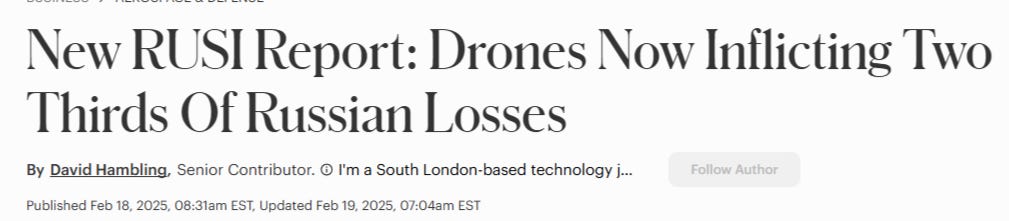
This makes sense, because Russia has a far larger preponderance of artillery and airforce assets which are responsible for a certain percentage of enemy losses, whereas Ukraine is forced to rely far more heavily on drones alone. However, to many people even the 50% Russian figure would come as a surprise, since there are still many ‘drone skeptics’ who believe that Russian artillery, airforce, and other assets far outweigh and overshadow drone usage.
Syrsky recently provided his own corollary in a new interview, stating that 60% of Russian losses come by way of Ukrainian drones:
Comrade Syrysky reports that Russia is conducting a strategic offensive operation on the territory of Ukraine with a grouping of 710 thousand people.
Against this backdrop, the Ukrainian commander-in-chief asked partners to increase the volume of international aid to Ukraine, especially in the field of air defense and long-range strike weapons.
Finally, today analysts reported the figures related to damage against Ukraine’s railway infrastructure as well, which has spiked considerably this year:
In continuation of today’s analysis by the Russian Ministry of Defense. According to Ukrainian data, over the past eight months, more than 100 attacks on Ukraine’s railway infrastructure have been recorded.
This is twice the number of attacks on railways recorded for the years 2023 and 2024 combined.
The priority of the attacks is the eastern regions of Ukraine, those bordering the Luhansk and Donetsk People’s Republics (LNR and DNR).
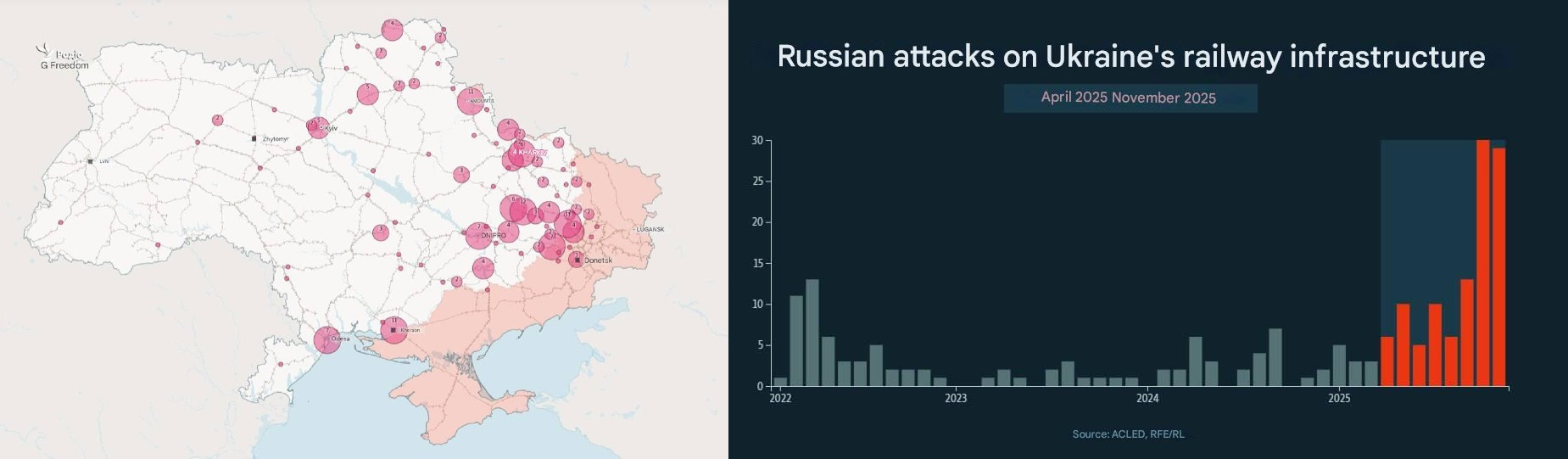
In short, this year Russia has really stepped up destroying all of Ukraine’s infrastructure in a concerted way.
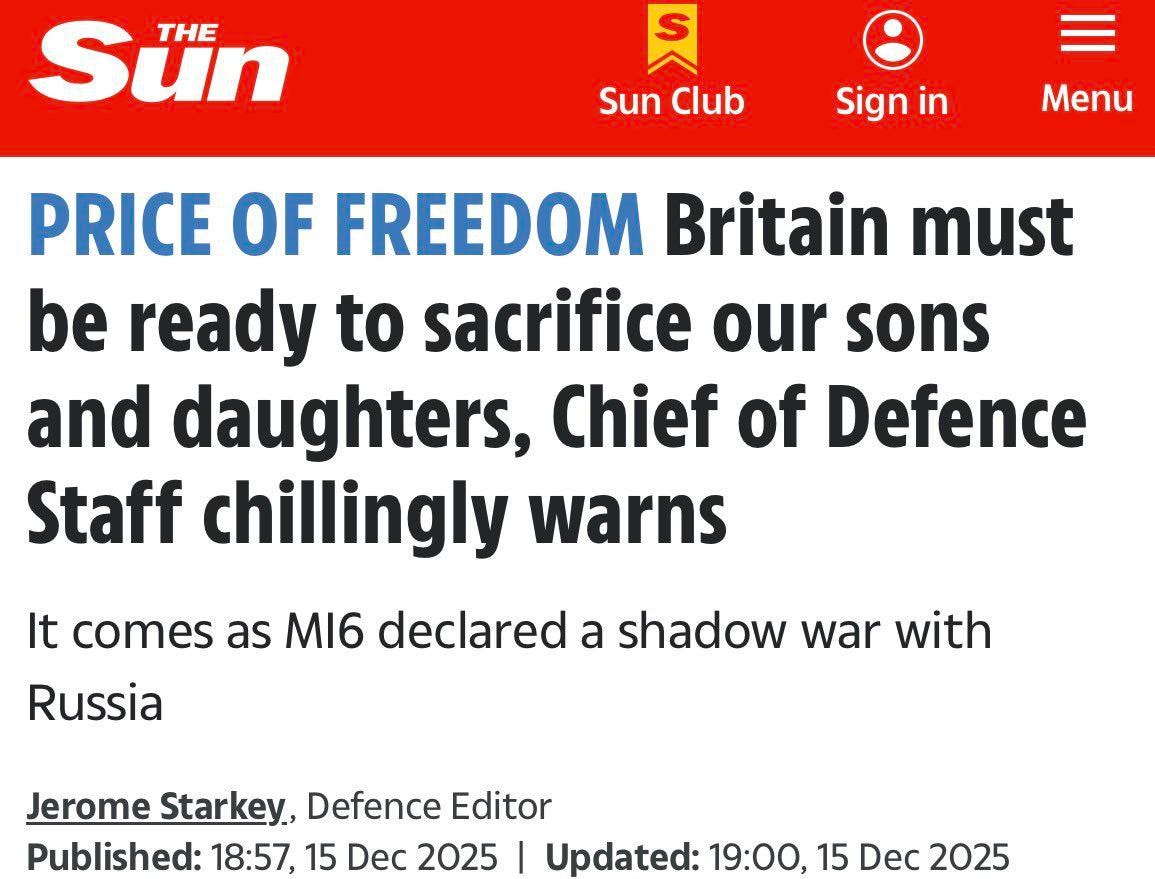
And how can we end without another small tip-o’-the-hat to the perennial British saber-rattling fear-train, which continues its cartoonish descent into farce: